
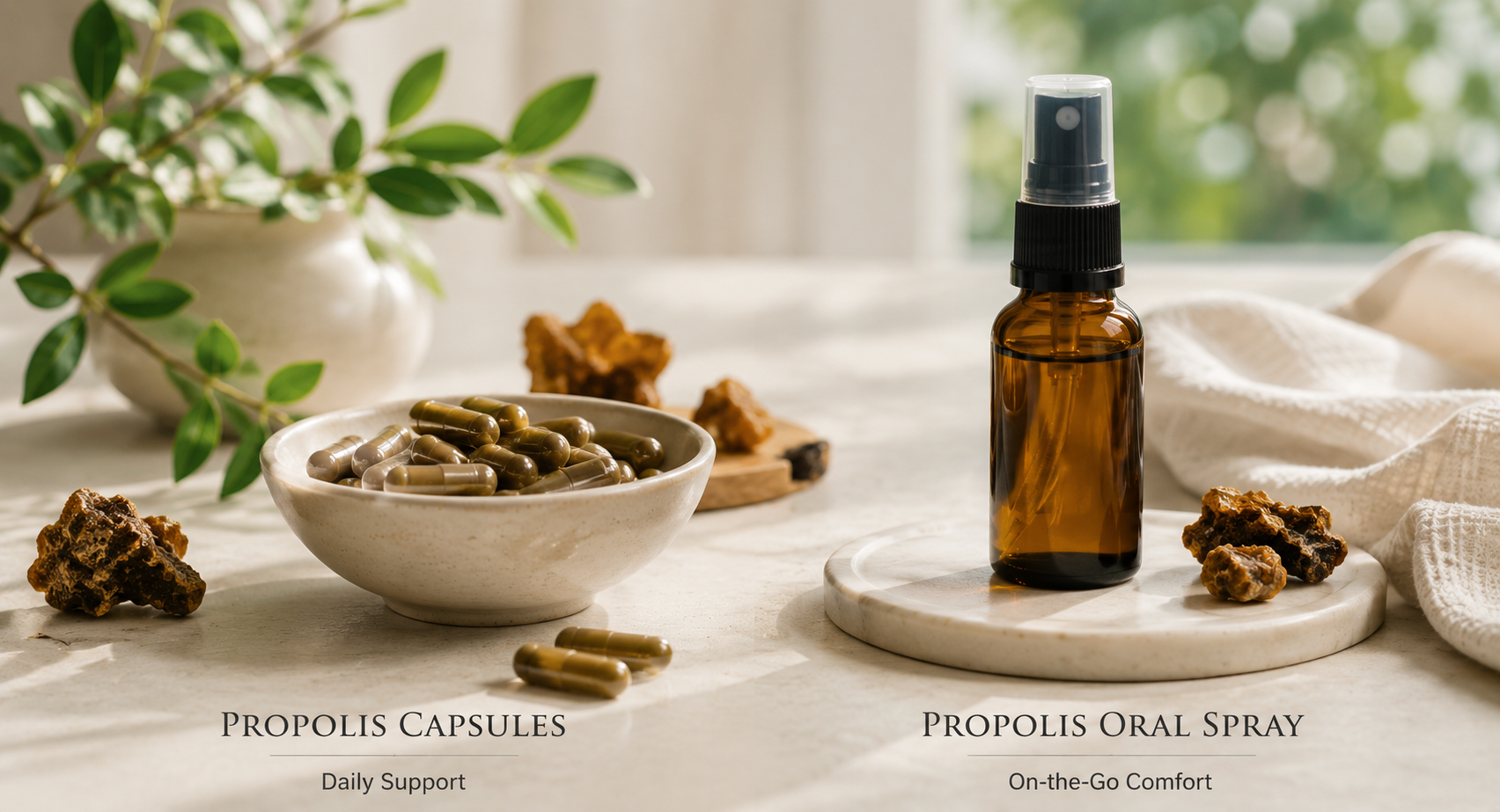
If you are weighing propolis capsules vs oral spray, you are comparing two practical ways to use the same bee-derived resin—not two unrelated ingredients. Capsules are swallowed as a measured serving. Oral spray is applied in the mouth and throat area. Those differences change taste, travel packing, and how the product fits a daily routine.
This Comparison Guide is part of the NaturalNZ Health Resource Center. It is written for U.S. readers who want a clear, evidence-aware way to choose a format—not a sales page that ranks one “best propolis supplement” for everyone.
NaturalNZ currently lists New Zealand propolis products in both formats, including capsules such as Natural NZ Propolis Max 5000mg 90 capsules, Peter & John Propolis 3500 300 capsules, and Peter & John Propolis 5000 200 capsules, plus oral sprays such as Manuka Science Propolis Oral Spray 30ml, Peter & John Propolis Spray 30ml, and Natural NZ Superior Propolis & Manuka Honey (MGO 830+) Oral Spray 30ml. Browse the live Propolis ingredient category for current listings.
This article is educational. It is not medical advice, and it does not diagnose, treat, cure, or prevent disease.
Quick Answer
Propolis capsules vs oral spray is mainly a lifestyle and use-case decision. Choose capsules if you want a measured daily serving, minimal taste, and a spill-resistant option that packs easily with other supplements. Choose an oral spray if you prefer local mouth/throat application, flexible on-the-go use without water, or a propolis throat spray style format. Neither form is universally stronger. After you pick a format, compare labels for serving directions, extract amount or brand strength markers (such as PFL where listed), other ingredients (including alcohol in some liquids/sprays), allergens, and bee-product warnings. People with bee-product allergies, asthma, or significant medical conditions should ask a clinician before use (Cleveland Clinic overview of propolis).
Key Takeaways
- Capsules favor measured routines, travel packing, and low taste.
- Oral sprays favor local mouth/throat application and quick, no-water use.
- “Best” depends on preference, label clarity, and consistency—not a single winning format.
- Research discusses antioxidant, inflammatory-marker, antimicrobial, and oral-health related areas; evidence quality varies by study, dose, and product.
- Bee products can trigger allergic reactions in sensitive people—stop use and seek care if symptoms appear.
- Always follow the product label; this guide does not replace labeled directions or medical advice.
- NaturalNZ also lists related formats (liquid extract, lozenges), but this comparison focuses on capsules vs spray.
Comparison Table
| Factor | Propolis Capsules | Propolis Oral Spray |
|---|---|---|
| Product Form | Capsule or softgel containing propolis extract/concentrate | Liquid mist directed into the mouth/throat |
| How It Is Used | Swallowed with water (follow label) | Sprayed into the mouth/throat area (follow label) |
| Convenience | High for established capsule routines | High for quick, no-water use |
| Travel Friendly | Excellent—compact, low spill risk | Good—portable; protect from leaks and heat |
| Taste | Usually minimal (capsule shell) | Often noticeable resin, honey, or botanical notes |
| Best For | Daily supplement-style routines | Local oral/throat comfort routines and on-the-go use |
| Daily Routine | Easy to pair with other capsules | Easy to keep at a desk, in a bag, or for travel days |
| Who May Prefer It | People who dislike spray taste or want measured capsules | People who want mouth/throat-focused application or dislike pills |
What Is Propolis?
Propolis is a resinous material bees collect from plant buds and exudates, then mix with beeswax and their own secretions to help seal and protect the hive. Manufacturers process it into supplements such as capsules, sprays, liquids, and lozenges.
Biomedical reviews describe propolis as chemically complex—flavonoids, phenolic acids, and other plant-derived compounds that vary by geography and botanical source. Human and laboratory research has explored antioxidant activity, inflammatory biomarkers, antimicrobial properties, and oral-health related applications (PMC narrative evidence review; PMC oral-health review; Frontiers meta-analysis of RCTs on inflammatory/oxidative markers).
Important buyer context:
- Composition varies by region, season, and processing—so labels matter more than slogans.
- Study findings do not guarantee the same outcome for every person or every commercial product.
- In the U.S., dietary supplements are regulated as foods, not drugs (FDA Dietary Supplements).
- Cleveland Clinic clinicians note that propolis is sometimes marketed for many uses, while allergy risk and evidence limits still matter for real-world decisions (Cleveland Clinic: Propolis).
If you are also exploring New Zealand bee-related foods, NaturalNZ’s guides on what Manuka honey is and Manuka honey benefits are useful companions for label literacy around bee products.
Capsules vs Oral Spray
Both formats deliver propolis. The meaningful differences are where and how you use them, plus taste, travel, and habit fit.
Capsules package a labeled serving inside a shell you swallow. They are usually the simplest option for people who already take daily supplements and want little flavor.
Oral sprays deliver a liquid mist to the mouth and throat area. Interest in spray formats is partly linked to clinical and review literature discussing standardized propolis oral sprays and upper-airway symptom research contexts (PMC respiratory/immunomodulation review; related PubMed record: PMID 35148666). That does not mean every commercial spray matches a study formula, dose, or result.
In short: capsules emphasize measured swallowing and low taste; sprays emphasize local oral use and flexible timing. Choose the behavior you can repeat consistently within labeled directions.

When Capsules May Be a Better Choice
Capsules may fit better when:
- You want a measured daily serving without thinking about spray technique.
- You prefer minimal taste.
- You travel often and want a spill-resistant format.
- Your routine already includes other capsules or softgels.
- You are comparing strength markers on labels (extract amount per capsule, capsule count, and any standardized rating listed by the brand).
NaturalNZ capsule examples currently listed
- Natural NZ Propolis Max 5000mg 90 capsules
- Peter & John Propolis 3500 300 capsules
- Peter & John Propolis 5000 200 capsules
Who may prefer capsules: adults who value predictability, travel packing, and a low-flavor daily habit.
When Oral Spray May Be a Better Choice
An oral spray may fit better when you want local application in the mouth and throat area, something you can use without water, or a portable bottle for desk and travel days. Taste is usually more noticeable than capsules, and some formulas include honey or other bee products—so read allergens carefully.

An oral spray may fit better when:
- You want local application in the mouth/throat area rather than only swallowing a capsule.
- You need something you can use without water.
- You prefer flexible timing (desk, commute, travel day) within labeled directions.
- You are comfortable with a stronger resin or honey-like taste.
- You specifically want a propolis throat spray style format for oral comfort routines (still follow the label; this is not a medical treatment claim).
NaturalNZ oral spray examples currently listed
- Manuka Science Propolis Oral Spray 30ml
- Peter & John Propolis Spray 30ml
- Natural NZ Superior Propolis & Manuka Honey (MGO 830+) Oral Spray 30ml
Who may prefer spray: people who dislike swallowing capsules, want on-the-go oral use, or prefer a mouth/throat-focused format.
Related formats (not the main comparison, but available): NaturalNZ also lists a liquid extract—Natural NZ SPL NZ Propolis PFL 22 Extract Liquid 25ml—and OnTheGO Propolis Manuka Lozenges for shoppers comparing beyond capsules and spray.
How to Read a Propolis Label
Use this checklist when comparing any bee propolis supplement comparison:
- Form and serving directions — capsules per day vs sprays per use; do not exceed labeled servings.
- Amount / strength markers — mg per capsule, extract ratio, or brand standardization terms (for example, some New Zealand products list PFL). Compare like with like.
- Other ingredients — fillers, alcohol (common in some liquid/spray extracts), honey, flavors, or sweeteners.
- Allergen and bee-product warnings — propolis can trigger allergic reactions; people with asthma or known bee-product allergy need clinician advice (Cleveland Clinic: Propolis; PMC oral-health review noting allergy risk).
- Storage — cool, dry place; protect sprays from heat and leakage.
- Claims language — prefer transparent composition over vague marketing. U.S. dietary supplements are not drugs (FDA Dietary Supplements; Mayo Clinic on dietary supplements).
- Verify with the product label for current ingredients, directions, and warnings before purchase—listings can change.
Frequently Asked Questions
1. What is the difference between propolis capsules and oral spray?
Capsules are swallowed as a measured unit. Oral sprays apply a liquid mist in the mouth/throat area. The ingredient category is the same (propolis), but use case, taste, and routine fit differ.
2. Which is better: propolis spray vs capsules?
Neither is universally better. Capsules usually win for travel and low taste. Sprays usually win for local oral use and no-water convenience. The better choice is the one you will use correctly and consistently according to the label.
3. Is a propolis throat spray the same as capsules?
No. A throat-oriented spray is designed for oral application. Capsules are for swallowing. Do not assume equal dose, absorption pattern, or sensory experience across formats.
4. How do you take propolis?
Follow the specific product label. Capsules are typically taken with water. Sprays are typically directed into the mouth/throat for a labeled number of sprays. Do not invent dosing from marketing copy.
5. What is the best propolis supplement?
The “best” option matches your preferred form, has a clear label, fits your routine and budget, and is appropriate for your health status. Compare current NaturalNZ listings in the Propolis category rather than relying on a single ranking.
6. Can I use capsules and spray together?
Some people use different formats at different times, but combining products can increase total propolis exposure and additive ingredients. Check labels and ask a healthcare professional before stacking products.
7. Does research support propolis for immune or oral wellness?
Peer-reviewed reviews discuss antioxidant, inflammatory-marker, antimicrobial, and oral-health related research, with mixed strength of evidence across topics and study designs (PMC evidence review; PMC oral-health review; Frontiers RCT meta-analysis). Supplements are not a substitute for medical care, sleep, nutrition, or clinician advice.
8. Are there side effects or allergy risks?
Yes. Bee products, including propolis, may cause allergic reactions in sensitive individuals. Cleveland Clinic notes allergy risk and advises caution for people with asthma or allergic conditions (Cleveland Clinic: Propolis). Stop use and seek medical care if you develop concerning symptoms.
9. Is New Zealand propolis different from other regions?
Propolis chemistry varies by plant sources and geography. “New Zealand propolis” describes origin/context; still read each label for extract markers, other ingredients, and directions rather than assuming all NZ products are identical.
10. Where can I compare NaturalNZ propolis products?
Use the live Propolis ingredient category and the product pages linked in this guide to compare current capsule and spray options.
Final Thoughts
Choosing propolis capsules vs oral spray is less about finding a universal winner and more about matching format to lifestyle. Capsules suit measured, travel-friendly daily habits. Oral sprays suit local mouth/throat application and quick use without water.
Stay evidence-aware, read labels carefully, and keep expectations realistic. If you are exploring bee-related New Zealand products more broadly, continue with NaturalNZ’s Manuka honey resources—What Is Manuka Honey? and Manuka Honey Benefits—then return to the Propolis category to compare formats that fit your routine.
References
- Braakhuis A. Evidence on the Health Benefits of Supplemental Propolis. Nutrients. 2019. PMC: https://pmc.ncbi.nlm.nih.gov/articles/PMC6893770/
- Magnavacca A, et al. The antiviral and immunomodulatory activities of propolis: An update and future perspectives for respiratory diseases. Biomedicine & Pharmacotherapy / PMC review. 2022. PMC: https://pmc.ncbi.nlm.nih.gov/articles/PMC9298305/
- Więckiewicz W, et al. Does Propolis Help to Maintain Oral Health? Evidence-Based Complementary and Alternative Medicine. 2013. PMC: https://pmc.ncbi.nlm.nih.gov/articles/PMC3556426/
- Frontiers in Nutrition. Propolis supplementation on inflammatory and oxidative stress biomarkers in adults: a systematic review and meta-analysis of randomized controlled trials. 2025. https://www.frontiersin.org/journals/nutrition/articles/10.3389/fnut.2025.1542184/full
- Esposito C, et al. Clinical study of a standardized propolis oral spray. PubMed: https://pubmed.ncbi.nlm.nih.gov/35148666/
- Cleveland Clinic. Propolis: Benefits, Uses and Side Effects. https://health.clevelandclinic.org/propolis
- Mayo Clinic. Dietary supplements: Do they help or hurt? https://www.mayoclinic.org/healthy-lifestyle/nutrition-and-healthy-eating/in-depth/supplements/art-20044894
- U.S. Food and Drug Administration. Dietary Supplements. https://www.fda.gov/food/dietary-supplements
- U.S. National Institutes of Health, Office of Dietary Supplements. Dietary Supplement Fact Sheets. https://ods.od.nih.gov/factsheets/list-all/
- Harvard T.H. Chan School of Public Health. The Nutrition Source — Dietary Supplements. https://nutritionsource.hsph.harvard.edu/supplements/
Medical Disclaimer
This article is for general educational purposes only and is intended for U.S. readers. It is not medical advice, diagnosis, or treatment. Propolis supplements are not medicines and are not intended to diagnose, treat, cure, or prevent any disease. Individual needs vary. Consult a qualified healthcare professional before starting any new supplement—especially if you are pregnant, nursing, giving products to children, have asthma or a known bee-product allergy, have a chronic medical condition, or take prescription medications. Always follow the product label and your clinician’s guidance. Verify current product details on the NaturalNZ website before purchase, as listings and formulations may change.
