

Walking into the supplement aisle—or scrolling an online shop—can make how to choose a colostrum supplement feel harder than it should. One product is a capsule. Another is a powder you stir into a drink. A third is a chewable tablet that tastes more like a snack than a capsule.
Those formats are not marketing accidents. They change how easy a product is to take, how it fits travel and family routines, and what you should check on the label. This buying guide is part of the NaturalNZ Health Resource Center. It is written to help U.S. readers compare colostrum capsules vs powder and chewable options with clear criteria—not to push a single “must-buy” product.
NaturalNZ lists several New Zealand colostrum products in capsule, powder, tablet, and chew formats. Examples below use only products currently available on the site, including Natural NZ Premium Booster Colostrum 1800 capsules, Peter & John Colostrum capsules, GoodHealth Colostrum Powder, Peter & John Biostrum Powder, Good Health Colostrum Milk Chews, Peter & John Biostrum tablets, and Natural NZ Goatstrum MBP tablets. Browse the full Colostrum ingredient category for current listings.
This article is educational. It is not medical advice, and it does not diagnose or treat disease.
Quick Answer
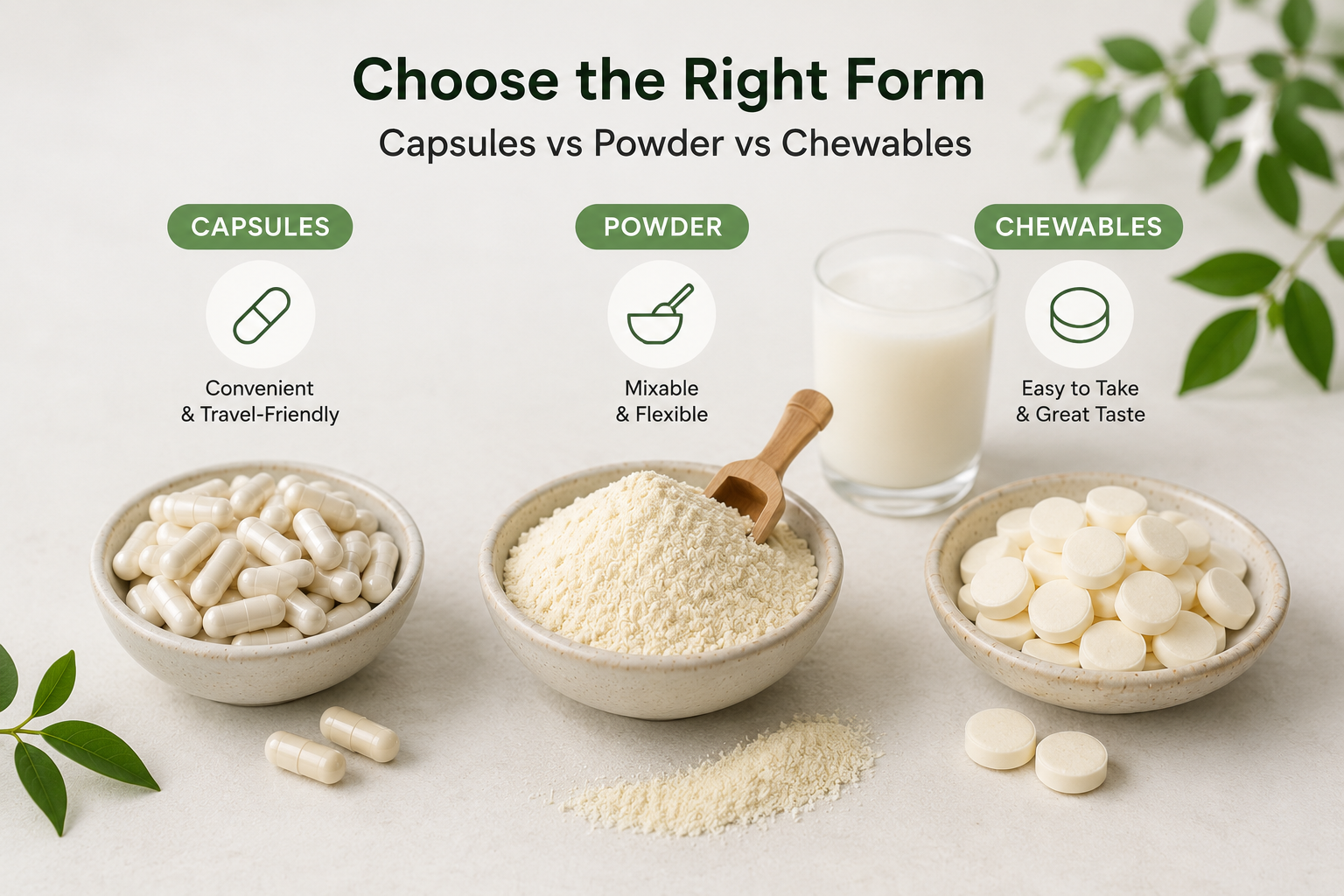
How to choose a colostrum supplement usually comes down to form first, then label details. Choose capsules if you want a measured, travel-friendly dose with little taste. Choose powder if you prefer mixing into drinks or food and want flexible serving size. Choose chewable tablets if you want convenience without swallowing capsules—especially for people who dislike pills. After form, verify source (often bovine or goat), serving size, immunoglobulin or protein information if listed, allergen statements, and storage directions. Prefer products with transparent labeling over vague “immune boost” marketing.
Key Takeaways
- Colostrum supplements commonly come as capsules, powders, and chewable or swallowable tablets—each suits different routines.
- Capsules prioritize convenience and travel; powders prioritize mixability and flexible use; chews prioritize ease of taking without water.
- A “best colostrum supplement” is the one that matches your preference, lifestyle, and label clarity—not a single universal winner.
- Read serving size, source animal (bovine vs goat), allergens, and storage notes before buying.
- Research on bovine colostrum is growing, especially around gastrointestinal and immune-related outcomes, but evidence quality varies and results are not uniform for every person.
- Children, pregnancy, dairy allergy, or medical conditions require clinician guidance before use.
- Use this guide with product labels and professional advice—not as a substitute for either.
Comparison Table
| Factor | Capsules | Powder | Chewable Tablets |
|---|---|---|---|
| Serving convenience | High — measured, ready to swallow | Medium — requires scooping/mixing | High — chew and go |
| Taste | Usually minimal | Noticeable milk/dairy notes possible | Often flavored / milky |
| Travel friendly | Excellent | Good if sealed; less packable than capsules | Excellent |
| Suitable for children | Depends on age/swallowing ability; ask a clinician | Often easier to mix into food/drink when age-appropriate | Often preferred when chewing is appropriate |
| Suitable for adults | Excellent for most adults | Excellent for adults who like mixing | Excellent for adults who dislike capsules |
| Mixing required | No | Yes | No |
| Storage | Cool, dry place; follow label | Keep sealed and dry; follow label | Cool, dry place; follow label |
| Daily routine fit | Best for capsule-based routines | Best for smoothie/drink routines | Best for chewable, no-water routines |
| Flexible serving size | Low | High | Medium |
What Is Colostrum?
Colostrum is the first milk mammals produce after giving birth. Compared with mature milk, it is denser in proteins, antibodies (immunoglobulins), and other bioactive compounds that support the newborn in early life. In supplements, bovine colostrum (from cows) is the most widely studied commercial source. Some products use goat colostrum instead.
Reviews in peer-reviewed literature describe bovine colostrum as containing immunoglobulins (especially IgG), lactoferrin, growth-factor peptides, oligosaccharides, and other bioactive components that researchers continue to study for gastrointestinal and immune-related applications (PMC review on bovine colostrum and human nutrition; systematic review of bovine colostrum applications).
Important context for buyers:
- Supplement use is not the same as newborn feeding physiology.
- Human studies exist, but study designs, doses, and populations differ, so outcomes are not guaranteed for every adult.
- Colostrum products are usually dairy-derived; people with milk allergy or lactose sensitivity need careful label review and medical advice.
If you are new to New Zealand wellness ingredients more broadly, you may also find NaturalNZ’s guides on what Manuka honey is and Manuka honey benefits useful as parallel label-literacy examples—different ingredients, same habit of checking source and quality markers.
Why Do Colostrum Supplements Come in Different Forms?
Manufacturers dry and process colostrum into formats that fit different use cases:
- Dose control — capsules and tablets deliver a fixed unit; powders allow flexible measuring.
- Palatability — some people prefer no taste (capsules); others accept milky flavor (powder/chews).
- Swallowing comfort — chews and powders help people who avoid hard capsules.
- Lifestyle fit — travelers often prefer capsules; home smoothie routines often prefer powder.
Form does not automatically mean “stronger” or “weaker.” What matters is the labeled serving, composition transparency, storage quality, and whether you will actually take it consistently.
Capsules
Capsules are often the simplest answer when people ask how to choose a colostrum supplement for everyday adult use.
Pros
- Measured serving with little preparation
- Minimal taste for most users
- Easy to pack for work, gym, or travel
- Fits established capsule routines
Cons
- Requires ability to swallow capsules comfortably
- Less flexible if you want to split a serving into food
- Less appealing for people who prefer chewable formats
NaturalNZ examples currently listed
Best fit: adults who want a clean, portable, no-mix option and already take capsules regularly.
Powder
Powder is useful when you want to incorporate colostrum into drinks or soft foods rather than swallow a capsule.
Pros
- Mixes into water, milk alternatives, yogurt, or smoothies (follow label)
- Flexible measuring within labeled directions
- Can feel more “food-like” for some users
- May suit people who dislike capsules
Cons
- Requires mixing and cleanup
- Taste and texture may be noticeable
- Travel packing is bulkier than a blister or bottle of capsules
- Moisture control matters—keep containers sealed
NaturalNZ examples currently listed
Best fit: people who already prepare morning drinks or prefer powder supplements over pills.
When comparing colostrum capsules vs powder, ask which friction point you can live with: swallowing a capsule, or measuring and mixing a powder. Consistency usually matters more than format prestige.
Chewable Tablets
Chewable tablets (and related chew/tablet formats) are designed for convenience without capsule swallowing.
Pros
- No water required for many chews
- Familiar format for people who prefer chewables
- Convenient for on-the-go routines
- May be easier for some older children or adults who dislike capsules (age-appropriate use only; ask a clinician)
Cons
- Flavor and sweetness vary by product
- Chewing preference is personal—some adults still prefer capsules
- Serving size and active amount still need label verification
- Not automatically “better for kids”—age, safety, and clinician advice still apply
NaturalNZ examples currently listed
- Good Health Colostrum Milk Chews 150 Tablets — chewable milk tablets
- Peter & John Biostrum 300Tabs — tablet format with bovine colostrum and goat milk formula
- Natural NZ Goatstrum MBP 200 Tablets — goat colostrum tablet option
Best fit: people specifically searching for colostrum chewable tablets or tablet formats, or anyone who wants an alternative to capsules and powders.
Who May Benefit from Different Colostrum Forms?
Different colostrum forms mainly serve different routines. The points below describe lifestyle fit—not medical outcomes.
Active adults
If your day includes workouts, commuting, or variable meal timing, capsules or chewables usually fit more easily than powders because they travel well and do not require mixing. Powder can still work if you already prepare post-workout drinks and prefer adding a scoop at home.
Busy professionals
For desk or shift schedules, the form you will take consistently matters most. Capsules support a fixed morning or evening pill routine. Chewables help when you are between meetings and do not have water nearby. Powder is practical only if you already make a daily drink at a predictable time.
Frequent travelers
Capsules and chewables are typically the simplest for flights, hotels, and carry-on packing. Powder remains usable if you keep it sealed and dry, but measuring and mixing away from home adds friction. For travel-heavy routines, convenience usually outweighs flexible scooping.
Older adults
Form choice often depends on swallowing comfort and daily habits. Capsules suit people who already take oral supplements comfortably. Chewables or powders may be easier for those who prefer not to swallow hard capsules—always following the product label and clinician guidance for age, dose, and dairy tolerance.
Which Form May Be Right for You?
There is no single best colostrum supplement for every household. Use lifestyle fit first, then confirm label quality.

Adults
Most adults do well with capsules if they already swallow vitamins easily. Choose powder if you prefer blending into a daily drink. Choose chews/tablets if you want something you can take without water or without a capsule.
Children
Do not assume adult products are appropriate for children. Age, dose, dairy tolerance, and product directions matter. Discuss any colostrum use with a pediatric clinician first. If a clinician approves a product, chewable or powder formats are sometimes easier than capsules for children who cannot swallow pills—but that is a clinical decision, not a shopping rule.
Travel
For travel, capsules and chews usually win. Powders can travel well in sealed containers, but airport packing and hotel mixing are less convenient.
Quick decision checklist
- Can you swallow capsules comfortably? → start with capsules.
- Do you already make daily drinks? → consider powder.
- Do you dislike pills and prefer chewing? → consider chews/tablets.
- Do you need goat rather than bovine source? → check labels carefully (for example goat-colostrum tablet options).
- Any dairy allergy, pregnancy, immune condition, or medication use? → ask a healthcare professional before purchase.
How to Read a Colostrum Supplement Label
A practical bovine colostrum supplement guide (and goat-colostrum guide) starts with the Supplement Facts panel and allergen statements.
1. Source animal
Confirm bovine (cow) or goat colostrum. They are not interchangeable for people with specific preferences or sensitivities.
2. Serving size and servings per container
Compare cost and convenience using servings, not bottle size alone.
3. Composition details
Some labels list immunoglobulin content, protein, or related markers. If a claim is made, look for specific numbers rather than vague wording. Absence of a single marketing number does not automatically mean a product is poor—but transparency is a positive signal.
4. Other ingredients
Note flavors, sweeteners, fillers, and any added vitamins/minerals in combination formulas.
5. Allergen and dairy statements
Colostrum is dairy-derived. Review milk allergen language carefully.
6. Directions and storage
Follow the manufacturer’s serving directions. Keep products dry and sealed unless the label says otherwise.
7. Quality cues
Look for clear brand identity, batch/lot information where provided, and country-of-origin context. New Zealand sourcing is a common reason shoppers compare brands on NaturalNZ, but origin alone does not replace label reading.
8. Health claims
Be cautious with absolute disease claims. Educational research summaries are not the same as personalized treatment claims. The FDA and responsible retailers treat supplements as foods, not drugs.
For a broader browse of currently listed options, use the Colostrum category.
Frequently Asked Questions
1. How do I choose a colostrum supplement if I am new to it?
Start with form preference (capsule, powder, or chew), then compare serving size, source animal, allergens, and storage. Begin with a product whose directions you can follow consistently, and ask a clinician if you have medical conditions or take medications.
2. Are colostrum capsules better than powder?
Not automatically. Capsules are usually more travel-friendly and taste-neutral. Powder is better if you prefer mixing into drinks. Choose based on lifestyle, not assumed potency.
3. What are colostrum chewable tablets good for?
Chewable tablets help people who dislike swallowing capsules and want a portable format. They are not automatically superior for immune or gut outcomes; they are a convenience format.
4. What is the best colostrum supplement?
The best option is the one you will take as directed, that matches your form preference, and that has clear labeling for source, serving, and allergens. There is no single best product for every person.
5. Is bovine colostrum the same as goat colostrum?
No. Both are colostrum from different animals. Most research discussed in reviews focuses on bovine colostrum. Goat-colostrum products exist for shoppers who prefer that source—always read the label.
6. Can children take colostrum supplements?
Only with clinician guidance. Age-appropriate dosing, dairy tolerance, and product directions must be confirmed by a healthcare professional.
7. Does colostrum help immunity or gut health?
Research reviews report potential effects related to immune modulation and gastrointestinal outcomes in certain study settings, but evidence quality and results vary. Supplements are not a substitute for medical care, vaccination, sleep, nutrition, or clinician advice (PubMed systematic review; PMC nutrition review).
8. Who should avoid colostrum supplements?
People with milk allergy should generally avoid dairy-derived colostrum unless a clinician advises otherwise. Those who are pregnant, nursing, immunocompromised, or managing chronic illness should seek medical advice first.
9. How should I store colostrum powder or capsules?
Follow the product label. In general, keep supplements sealed, dry, and away from heat and humidity. Do not use products that smell off, clump abnormally (for powders), or are past the labeled date.
10. Where can I compare NaturalNZ colostrum products?
Use the live Colostrum ingredient category and individual product pages linked in this guide to compare current forms and labels.
11. Can I take colostrum every day?
Many commercial colostrum products are labeled for regular daily use according to the serving directions on the package. Whether daily use is appropriate for you depends on the specific product, your overall diet, dairy tolerance, and any medical conditions or medications. Published reviews discuss bovine colostrum in short-term and varied study settings; they do not establish one universal long-term dosing schedule for every adult. Follow the manufacturer’s directions, avoid exceeding labeled servings, and ask a healthcare professional before starting daily use—especially if you are pregnant, nursing, immunocompromised, managing a chronic condition, or giving a product to a child.
Final Thoughts
Learning how to choose a colostrum supplement is mostly a practical decision: capsules for measured convenience, powder for mix-in flexibility, and chewable tablets for no-capsule ease. Use research-informed expectations—colostrum is an interesting dairy bioactive food with growing study interest—but keep claims grounded and personalized medical questions with your clinician.
If you are comparing formats today, start with the Colostrum category on NaturalNZ, then match the form to your daily routine and label preferences.
References
- Playford RJ, Weiser MJ. Bovine Colostrum and Its Potential for Human Health and Nutrition. Frontiers in Nutrition. 2021. PubMed Central: https://pmc.ncbi.nlm.nih.gov/articles/PMC8255475/
- Guberti M, et al. Bovine Colostrum Applications in Sick and Healthy People: A Systematic Review. Nutrients. 2021;13(7):2194. PubMed: https://pubmed.ncbi.nlm.nih.gov/34202206/ | Full text: https://www.mdpi.com/2072-6643/13/7/2194
- Kaplan M, et al. Clinical Applications of Bovine Colostrum in Gastrointestinal Disorders: Mechanisms, Evidence, and Therapeutic Potential. Nutrients. 2025. PubMed: https://pubmed.ncbi.nlm.nih.gov/41226709/ | PMC: https://pmc.ncbi.nlm.nih.gov/articles/PMC12608013/
- U.S. National Institutes of Health, Office of Dietary Supplements. Dietary Supplement Fact Sheets (consumer context for supplement use and labeling literacy). https://ods.od.nih.gov/factsheets/list-all/
- U.S. Food and Drug Administration. Dietary Supplements. https://www.fda.gov/food/dietary-supplements
- MedlinePlus (U.S. National Library of Medicine). Milk Allergy. https://medlineplus.gov/ency/article/000807.htm
- Harvard T.H. Chan School of Public Health. The Nutrition Source — Dietary Supplements. https://nutritionsource.hsph.harvard.edu/supplements/
Medical Disclaimer
This article is for general educational purposes only and is intended for U.S. readers. It is not medical advice, diagnosis, or treatment. Colostrum supplements are not medicines and are not intended to diagnose, treat, cure, or prevent any disease. Individual needs vary. Consult a qualified healthcare professional before starting any new supplement—especially if you are pregnant, nursing, giving products to children, have a milk allergy or lactose intolerance, have an immune or gastrointestinal condition, or take prescription medications. Always follow the product label and your clinician’s guidance. Verify current product details on the NaturalNZ website before purchase, as listings and formulations may change.
