
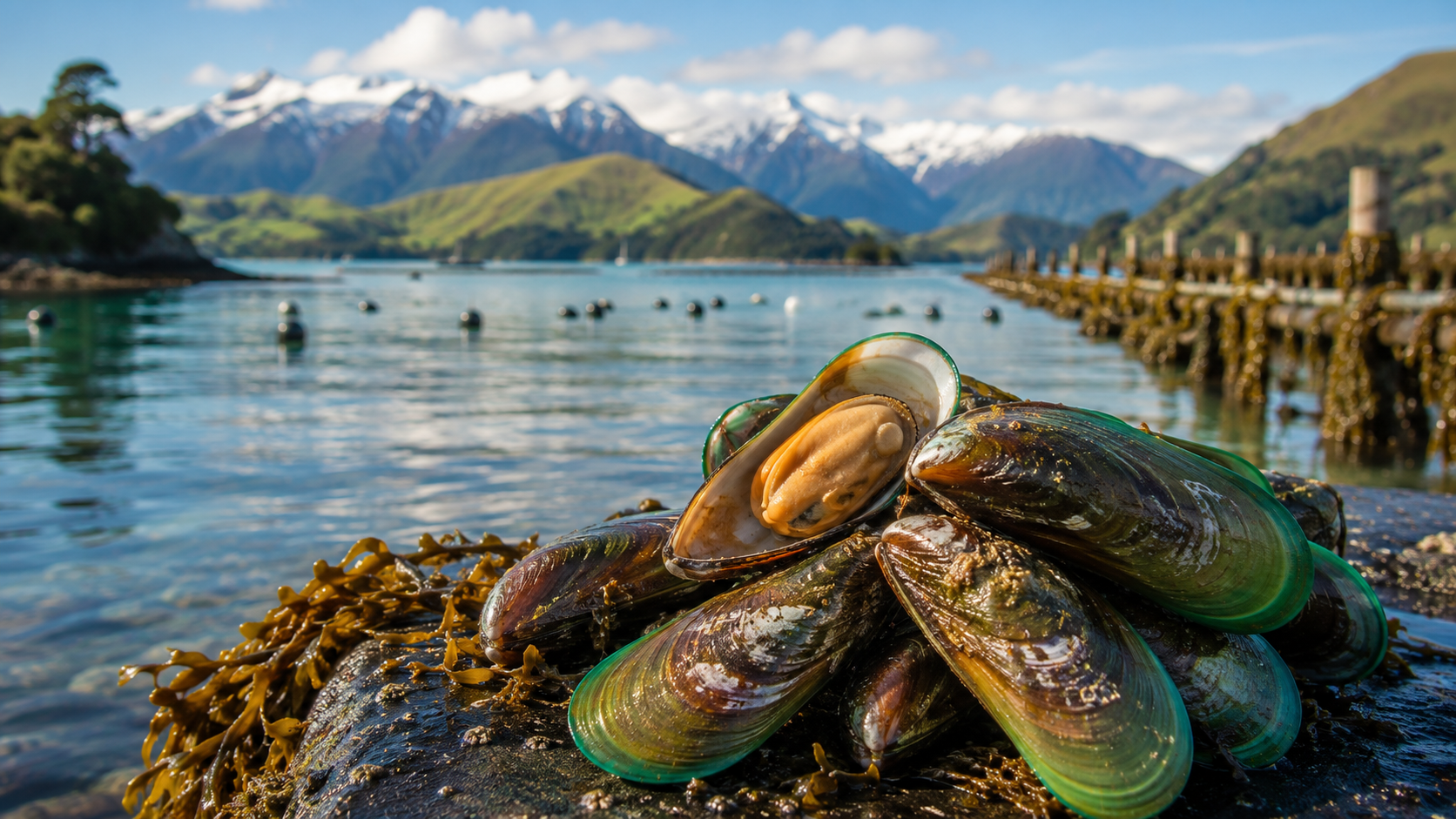
If you are comparing green lipped mussel supplement labels, you have probably seen coastal New Zealand photography, joint-support claims, and numbers such as “22,500 mg equivalent.” Some products highlight freeze-dried powder. Others emphasize New Zealand mussel oil or concentrated extracts. It is reasonable to ask what is genuinely different about New Zealand green lipped mussel—and what is standard supplement marketing.
The factual starting point is biological identity. Green lipped mussel refers to Perna canaliculus, a species indigenous to New Zealand and widely known in seafood and aquaculture as Greenshell™ mussel. That native association matters for species identification, marine sourcing, and traceability. It does not mean every product works the same way, or that New Zealand origin alone guarantees a specific health outcome.
This article is part of NaturalNZ’s Why New Zealand Wellness? editorial series—educational content for U.S. and international readers exploring New Zealand ingredients and supplement literacy. It is not medical advice and does not diagnose or treat joint conditions.
Table of Contents
- Direct Answer
- What Is Green Lipped Mussel?
- Why Is Green Lipped Mussel Associated with New Zealand?
- Perna canaliculus: Why Species Matters
- What Makes Green Lipped Mussel Different from Other Mussels?
- New Zealand Marine Sourcing Context
- Whole Mussel Powder vs Extract vs Mussel Oil
- Why Processing Methods May Matter
- What Does Scientific Research Say?
- What Current Research Does Not Prove
- How to Compare Green Lipped Mussel Supplements
- Safety and Considerations
- Frequently Asked Questions
- Conclusion
Direct Answer
Why is New Zealand green lipped mussel different? It usually refers to Perna canaliculus, a mussel species indigenous to New Zealand and farmed under New Zealand aquaculture frameworks—not the same as unspecified “mussel extract” or other shellfish species. Supplements may use freeze-dried flesh, oils, or concentrated extracts, so composition varies by product. Research on green lipped mussel for joint comfort is mixed: a 2021 systematic review reported modest pain-related outcomes in osteoarthritis contexts in selected trials, while other randomized trials have not shown clear benefit on primary outcomes. Shellfish allergy is a serious contraindication.
Key Takeaways
- Green lipped mussel usually means Perna canaliculus, native to New Zealand waters and farmed as Greenshell™ mussel.
- Species identity, marine sourcing, and processing format are separate from clinical outcome claims.
- Freeze-dried powder, mussel oil, and concentrated extracts are not interchangeable on the label.
- MPI and industry frameworks govern aquaculture context; they do not prove a supplement works for your joints.
- Peer-reviewed research is mixed and mostly tied to osteoarthritis trial designs—not universal pain relief.
- People with shellfish allergy should avoid green lipped mussel supplements unless a clinician advises otherwise.
What Is Green Lipped Mussel?
Green lipped mussel (Perna canaliculus) is a marine bivalve in the true mussel family (Mytilidae). NIWA describes Greenshell™ mussel—the same species—as indigenous to New Zealand, with a life cycle that includes a pelagic larval stage before settlement and growth.
Distinctive features include:
- A green lip on the shell edge (the source of the common English name)
- Large adult size compared with many common food mussels
- Economic importance in New Zealand aquaculture and seafood exports
In te reo Māori, the species is known as kuku or kūtai. The species is also commercially known as Greenshell™ mussel in New Zealand aquaculture and seafood contexts.
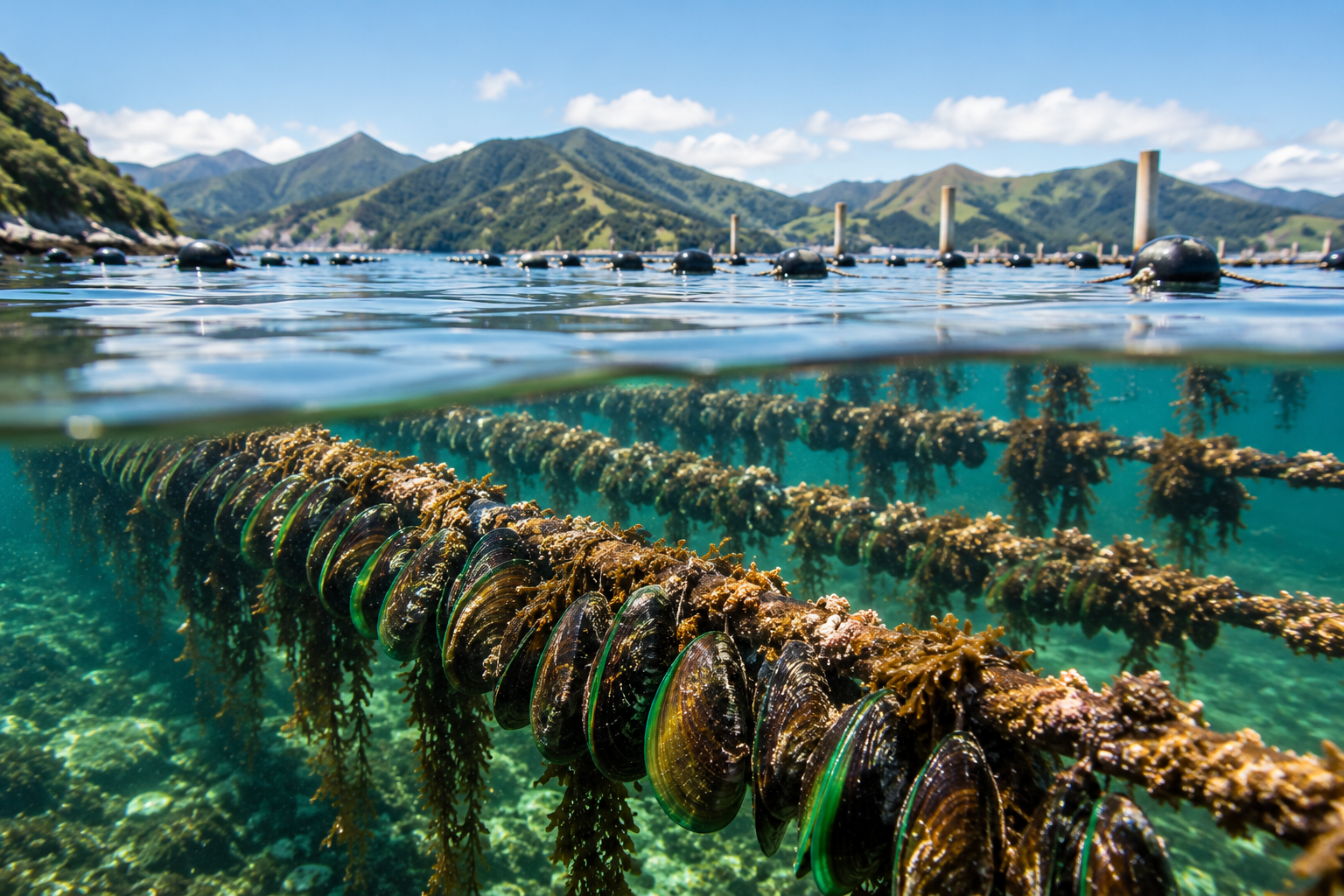
As filter feeders, Greenshell™ mussels take nutrients from seawater. Seafood New Zealand notes they are farmed on lines in regions such as the Marlborough Sounds, Coromandel, Golden Bay, and Stewart Island, under resource consents that govern farm size, monitoring, and permitted activities.
Why Is Green Lipped Mussel Associated with New Zealand?
Three overlapping facts explain the New Zealand association:
1. Native species status. Perna canaliculus is described by New Zealand marine science and seafood bodies as indigenous to New Zealand waters—not a species farmed globally in the same way as blue mussel (Mytilus) commodities.
2. Aquaculture infrastructure. New Zealand has a long-established Greenshell™ mussel industry with farming, harvesting, processing, and export systems. The Ministry for Primary Industries (MPI) oversees aquaculture management, sustainability planning, and biosecurity frameworks for farmed fish and shellfish.
3. Supplement category history. Green lipped mussel became known internationally largely through joint-comfort research using New Zealand–sourced material. That research history shapes how the ingredient is marketed—even though products and evidence vary.
Association with New Zealand is about species identity and supply-chain context. It is not a shorthand for “clinically proven for your joints.”
Perna canaliculus: Why Species Matters
Not every product labeled “mussel” is Perna canaliculus.
Seafood New Zealand distinguishes Greenshell™ mussels from the related blue mussel (Mytilus edulis aoteanus), which is abundant around and south of Cook Strait but is a different species with a different commercial profile. Generic “mussel extract” supplements may use other species, blends, or unspecified shellfish sources.
| Label language | What to verify |
|---|---|
| Green lipped mussel / Perna canaliculus | Latin name matches P. canaliculus |
| Greenshell™ mussel | Trademarked New Zealand branding; still read supplement facts |
| Mussel extract (unspecified) | Species and country of origin may be unclear |
| New Zealand made | Manufacturing location—not always the same as ingredient source |
Country of origin and species identity are separate questions. A capsule can be manufactured outside New Zealand while containing New Zealand–sourced mussel—or the reverse.
What Makes Green Lipped Mussel Different from Other Mussels?
Indigenous species, not a global commodity mussel
Perna canaliculus is tied to New Zealand as a native aquaculture and wild species. That differs from importing generic mussel meat or unspecified extracts assembled without clear species documentation. The distinction is biological and supply-chain identity, not automatic superiority over every other country’s seafood.
Established aquaculture and seafood infrastructure
New Zealand’s Greenshell™ industry has decades of farming and export experience. NIWA documents research and aquaculture support for the species. Supplement manufacturers may draw on food-grade mussel streams, but processing for capsules is a separate step with its own quality controls.
Lipid profile and whole-food matrix
Green lipped mussel is discussed in research partly because of its lipid content and whole-tissue matrix—not only because it is a mussel. Supplement formats differ in which fractions are retained. Higher milligram equivalence on a label does not automatically mean stronger clinical evidence.
Research context—not a uniform drug effect
International interest grew through osteoarthritis and joint-comfort studies. That history defines the supplement category, but trial results are not uniform across products, doses, and study designs.
New Zealand Marine Sourcing Context
Marine ingredients New Zealand shoppers care about often begin with water quality, farm location, and regulatory oversight—not marketing photography.
MPI’s aquaculture section describes government management of the industry for growth and sustainability, including marine farm establishment rules, biosecurity protection, and environmental standards. Seafood New Zealand adds industry context on where Greenshell™ mussels are farmed and how consenting works at a high level.
For supplement buyers, useful sourcing questions include:
- Is the ingredient identified as Perna canaliculus?
- Does the brand state New Zealand source, and can it provide documentation if asked?
- Is the product freeze-dried powder, oil, or extract—and how is potency described?
- Are batch codes and company contact details available for traceability?
Sourcing transparency supports informed comparison. It does not replace clinical evidence or medical advice for persistent joint symptoms.
Whole Mussel Powder vs Extract vs Mussel Oil
These are the most common green lipped mussel supplement formats. They are not interchangeable.
| Format | General description | Typical shopper note |
|---|---|---|
| Freeze-dried powder | Dehydrated mussel flesh | Whole-food matrix; potency stated as powder weight or “fresh mussel equivalent” |
| Mussel oil / lipid extract | Oil fraction from mussel tissue | Often marketed for lipid content; serving size differs from powder |
| Concentrated extract | Processed extract with equivalence claims | Read whether equivalence refers to fresh mussel weight, extract weight, or another basis |

New Zealand mussel oil products may emphasize omega-3 and other marine lipids. Powder products may emphasize the broader tissue matrix studied in some trials. Extract products may use concentrated equivalence statements (for example “22,500 mg equivalent”). Each approach reflects different processing choices—not a single standardized active ingredient like a pharmaceutical.
Why Processing Methods May Matter
Processing affects what reaches the capsule:
- Drying method (for example freeze-drying vs other dehydration) can influence heat-sensitive components.
- Extraction solvents and fractionation change which lipids and proteins remain.
- Stabilization and encapsulation affect shelf life and serving consistency.
Official manufacturer technical sheets may describe these steps factually. Processing details explain product differences; they do not by themselves prove clinical benefit.
When labels use equivalence language, ask what the number refers to. “Equivalent to X mg fresh mussel” is not the same as “you ingest X mg of powder per capsule.”
What Does Scientific Research Say?
Evidence must be described carefully—especially for U.S. readers evaluating joint support ingredients.
Systematic review
A 2021 systematic review in Inflammopharmacology analyzed clinical trials of green-lipped/greenshell mussel (Perna canaliculus) extracts in osteoarthritis patients. The authors reported that pooled results from selected trials showed a moderate effect on pain scores on a visual analogue scale, while noting that evidence is limited by the number and quality of studies and that more large, high-quality trials are needed. General tolerability was reported in most included studies.
That is not proof that every green lipped mussel product improves every person’s joints.
Mixed randomized trial results
Not all trials are positive. A randomized, double-blind, placebo-controlled trial of a novel extract (BioLex®-GLM) in moderate to severe hip or knee osteoarthritis did not show clinical benefit on primary pain outcomes over 12 weeks, though authors noted aspects worth further study, such as longer duration or different dosing.
Summary: Research has examined green lipped mussel extracts mainly in osteoarthritis-related joint pain contexts, with mixed results depending on product, dose, duration, and study design.
What Current Research Does Not Prove
- Green lipped mussel supplements do not cure osteoarthritis or any joint disease.
- New Zealand origin does not guarantee clinical improvement.
- Traditional use or anecdotal reports do not replace clinical evidence.
- Animal or laboratory studies do not automatically translate to human outcomes.
- “Natural,” “marine,” or “New Zealand made” labels do not prove safety for every individual—especially with shellfish allergy or medication interactions.
Always consult a healthcare professional for joint pain that is persistent, severe, or accompanied by swelling, redness, fever, or sudden injury.
How to Compare Green Lipped Mussel Supplements
Before buying, compare labels for:
- Species: Perna canaliculus or clear “green lipped mussel” identity
- Form: powder, oil, or extract—and what one serving actually contains
- Equivalence language: understand the basis for “mg equivalent” claims
- Allergen statements: shellfish warnings must be clear
- Brand traceability: batch codes, company contact, sourcing documentation where provided
- Realistic expectations: supplements are not replacements for medical care, physical therapy, or prescribed treatment
After you understand what you are comparing, explore Green Lipped Mussel supplements, the Green Lipped Mussel ingredient category, and Joint Health collections at NaturalNZ. For more ingredient education, browse Ingredient Guides on the NaturalNZ blog.
Safety and Considerations
Green lipped mussel is a shellfish-derived ingredient.
- Shellfish allergy: Avoid unless a qualified healthcare provider says otherwise. Allergic reactions to mollusks can be serious.
- Anticoagulant or antiplatelet medicines: If you take anticoagulant or antiplatelet medicines, ask a healthcare professional before using a green lipped mussel supplement, particularly an oil-based product. Evidence on clinically significant interactions is limited.
- Pregnancy and breastfeeding: Follow label warnings; many products advise medical consultation.
- Surgery: Some labels recommend stopping use before surgery—check your product and clinician guidance.
Mild digestive symptoms are reported in some studies and user reports. This is not a complete safety list.
Frequently Asked Questions
What is New Zealand green lipped mussel?
It is typically Perna canaliculus, a mussel species native to New Zealand, also marketed as Greenshell™ mussel in seafood and ingredient contexts.
Is green lipped mussel only found in New Zealand?
Perna canaliculus is described by New Zealand aquaculture and seafood sources as indigenous to New Zealand. That native status is a core reason the ingredient is discussed separately from generic mussel products.
What is Perna canaliculus?
Perna canaliculus is the scientific name for green lipped mussel—the species associated with New Zealand Greenshell™ mussel farming and green lipped mussel supplements.
Is green lipped mussel the same as glucosamine or chondroitin?
No. They are different ingredients. Some joint formulas combine multiple ingredients; read the supplement facts panel for what your product actually contains.
Does green lipped mussel help joint pain?
Some clinical trials and a systematic review report modest pain-related outcomes in osteoarthritis research contexts, but evidence is mixed and product-dependent. It is not proven for everyone and is not a cure.
Is freeze-dried mussel better than mussel oil?
They are different formats with different serving sizes and compositions. One is not universally “better”—it depends on product standardization, your needs, and label transparency.
Can I take green lipped mussel if I have a shellfish allergy?
People with shellfish allergy should generally avoid green lipped mussel supplements unless a clinician advises otherwise.
What does “22,500 mg equivalent” mean on a label?
It usually means the extract is concentrated to an equivalence statement relative to fresh mussel weight. It does not mean you swallow 22,500 mg in one capsule, and it does not by itself prove clinical effect.
Are New Zealand green lipped mussel supplements regulated?
New Zealand’s dietary supplement regulatory framework is currently changing. The Dietary Supplements Regulations 1985 were scheduled to expire on 1 March 2026, and the New Zealand Government has been reviewing future regulatory options for dietary supplements and natural health products. Depending on how a product is classified and sold, requirements under New Zealand food, consumer protection, medicines, and other applicable laws may still apply.
For international buyers, regulatory status should not be treated as proof that a green lipped mussel supplement is clinically effective. Products sold to U.S. customers must also meet applicable U.S. market requirements. Check the product label, ingredient identity, manufacturer or sponsor details, and current official guidance when comparing supplements.
How do I find more NaturalNZ articles on this ingredient?
Browse Ingredient Guides and the NaturalNZ blog for additional green lipped mussel and joint-health education as it is published.
Conclusion
New Zealand green lipped mussel is different in a specific, factual sense: it refers to a native New Zealand species (Perna canaliculus) with established aquaculture, distinct Greenshell™ branding, and a research history mainly tied to joint-comfort studies—not because “New Zealand” on a label automatically means better results.
If you are comparing supplements, prioritize species identity, form, label transparency, marine sourcing context, and realistic evidence over coastal photography or large equivalence numbers. For persistent joint symptoms, work with a qualified healthcare professional on diagnosis and treatment options.
NaturalNZ publishes ingredient education across Ingredient Guides, Joint Health, and Green Lipped Mussel collections to help shoppers understand New Zealand wellness ingredients before they buy.
Medical disclaimer: This article is for general educational purposes only and does not diagnose, treat, cure, or prevent any disease. It is not a substitute for professional medical advice. Always seek the advice of your physician or qualified health provider with questions about joint pain, osteoarthritis, shellfish allergy, medications, or supplements.
