
Quick Answer
Manuka honey from New Zealand is valued mainly for its non-peroxide antibacterial activity, linked to compounds such as methylglyoxal (MGO). Research supports some uses—especially in wound care settings and certain oral health applications—when medical-grade honey is used appropriately. For everyday eating, Manuka honey can be part of a balanced diet, but it is still an added sugar. It is not a treatment for infections, diabetes, digestive disease, or any other medical condition. Benefits depend on authenticity, rating, dose, and how the honey is used.
Key Takeaways
- Manuka honey’s standout feature is antibacterial activity that does not rely on hydrogen peroxide, often measured through UMF or MGO ratings.
- Strongest evidence exists for topical medical honey used under professional guidance—not for replacing prescribed care with jarred table honey.
- Oral consumption research is promising but limited; more high-quality human studies are needed.
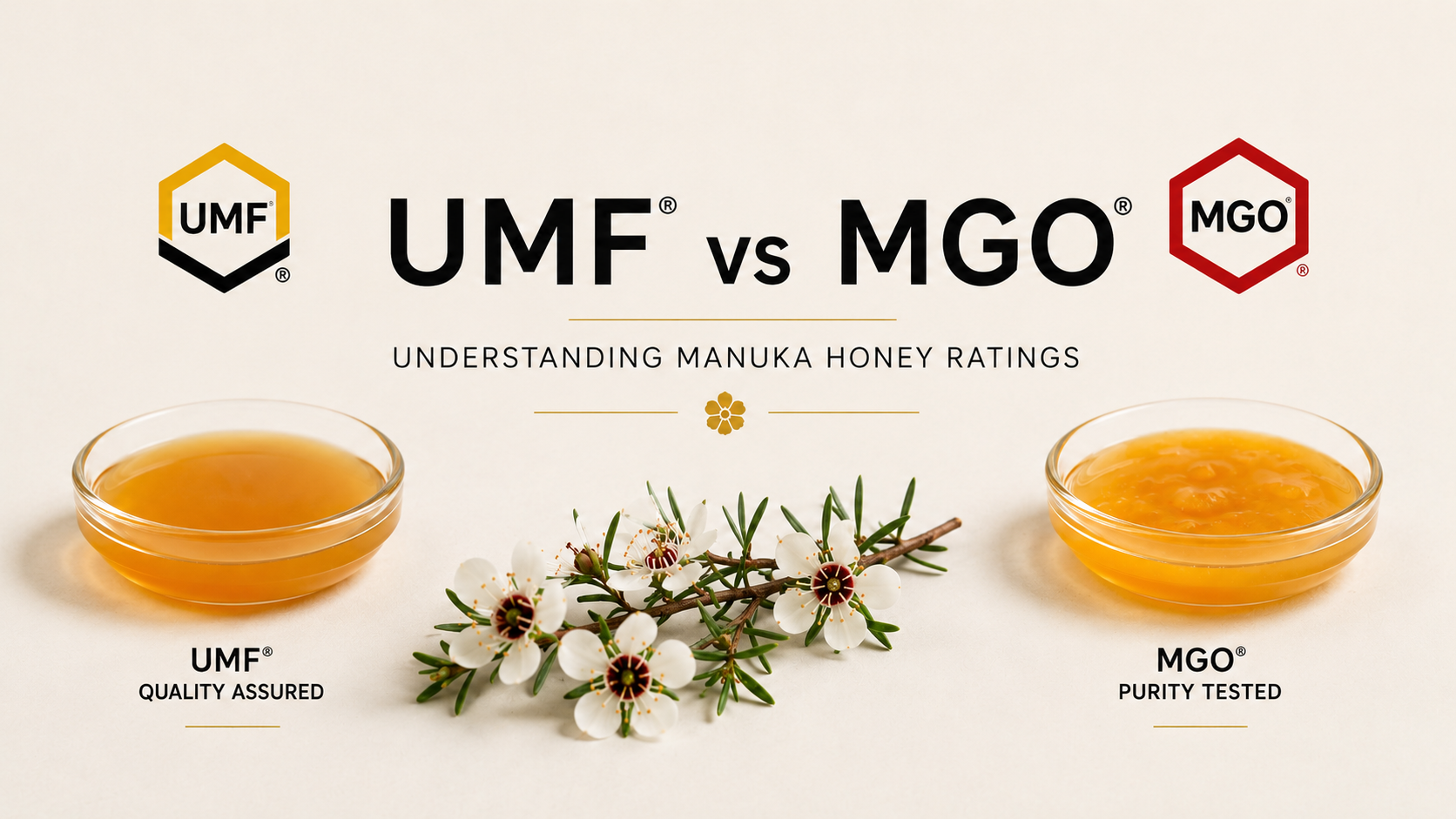
- UMF and MGO are different labeling systems; both aim to communicate activity level, but they are not interchangeable numbers.
- Authentic Manuka honey should be monofloral, traceable to New Zealand, and sold with clear grading from reputable brands.
- Manuka honey is not safe for infants under 12 months because of botulism risk.
- People with diabetes, allergies to bee products, or planned surgery should talk with a clinician before regular use.
Quick Facts Table
| Topic | What to Know |
|---|---|
| Botanical source | Nectar from Leptospermum scoparium (mānuka plant), primarily New Zealand |
| Key compound | Methylglyoxal (MGO), associated with non-peroxide antibacterial activity |
| Common ratings | UMF™ (Unique Manuka Factor), MGO (mg/kg), sometimes NPA |
| Best-supported use | Medical-grade honey in wound care (clinical setting) |
| Everyday use | Food and wellness support within a balanced diet |
| Not proven | Cures infections, replaces medicine, guaranteed immune “boosting” |
| Infant safety | Avoid under 12 months |
| Sugar content | ~80% carbohydrates; counts as added sugar |
| Authenticity | Look for reputable grading, batch traceability, New Zealand origin |
| More reading | See What Is Manuka Honey?, UMF Rating Explained, MGO Rating Guide |
Table of Contents
- Introduction
- What Makes Manuka Honey Different?
- How UMF and MGO Relate to Benefits
- Potential Benefits Supported by Research
- Benefits vs. Marketing Claims
- Comparison Tables
- Pros and Cons
- Scientific Evidence Summary
- Expert Tips for Safe, Smart Use
- Buying Guide: Choosing Authentic Manuka Honey
- Common Mistakes Shoppers Make
- FAQ
- People Also Ask
- External References
- Related Reading
- Conclusion
- Recommended NaturalNZ Products
Introduction
If you have searched for manuka honey benefits, you have probably seen bold promises: stronger immunity, better digestion, clearer skin, and “natural antibiotic” effects. Some marketing goes far beyond what peer-reviewed science supports.
Manuka honey is genuinely interesting. It comes from the mānuka tree (Leptospermum scoparium) in New Zealand and has chemical markers—especially methylglyoxal (MGO)—that distinguish it from most supermarket honey. That uniqueness is real. The gap appears when those lab findings are turned into guaranteed health outcomes for every jar on a shelf.
This guide is for U.S. readers who want a clear, evidence-based overview: what research supports, what remains uncertain, and how to shop without overpaying for vague labels. If you are new to the category, start with What Is Manuka Honey? for definitions and origin basics. Shoppers comparing labels may also find our Manuka vs Regular Honey guide helpful before diving deeper.
NaturalNZ editorial standards require transparent sourcing, conservative health language, and respect for regulatory boundaries. We sell New Zealand wellness products, but this article is educational—not a substitute for medical advice.
What Makes Manuka Honey Different?

Monofloral source and New Zealand origin
Authentic Manuka honey is primarily produced when bees collect nectar from mānuka flowers. New Zealand’s Ministry for Primary Industries (MPI) has implemented scientific definition and export testing requirements for monofloral and multifloral mānuka honey, using marker compounds and DNA markers from mānuka pollen. That framework matters because global demand created a flood of mislabeled products. For a broader look at origin and labeling across the category, see New Zealand Honey.
Non-peroxide antibacterial activity
Most honey has some antibacterial effect from hydrogen peroxide. Manuka honey is noted for non-peroxide activity, meaning activity remains even when peroxide is neutralized. This is commonly discussed through:
- UMF™ (Unique Manuka Factor), which reflects non-peroxide activity and related quality markers in a licensed testing framework.
- MGO content, expressed as mg/kg, measuring methylglyoxal concentration.
Neither number tells the whole story alone, but together with brand testing and traceability they help shoppers compare products. For label details, read UMF Rating Explained and MGO Rating Guide.
Not all “Manuka” jars are equal
Blended honey, unclear grading, or absent batch data can mean you are buying ordinary honey at a premium price. Authentication is part of the benefit conversation—you cannot separate “what it might do” from “whether the jar is real.” Our guide to Authentic Manuka Honey walks through verification steps in more detail.
How UMF and MGO Relate to Benefits
Higher ratings generally indicate higher measured activity, but more is not always better for daily eating. A moderate-grade honey may suit routine wellness use, while higher grades are often chosen for specific goals or shorter-term use.
| Rating type | What it measures | Shopper tip |
|---|---|---|
| UMF™ | Non-peroxide activity plus quality markers in licensed framework | Look for UMFHA license on label |
| MGO | Methylglyoxal concentration (mg/kg) | Compare like with like; not equal to UMF number |
| NPA | Non-Peroxide Activity (sometimes listed) | Understand conversion charts from reputable brands |
Important limitation: Activity measured in a lab does not automatically equal clinical benefit when you eat a teaspoon at breakfast. Digestion, dose, frequency, and individual health status all matter.
Potential Benefits Supported by Research
Understanding manuka honey benefits requires separating what has been studied in controlled settings from what sellers imply on packaging. The sections below reflect published research areas—not promises of personal outcomes.
1. Wound and skin care (strongest evidence area)
Medical-grade honey dressings have been studied for burns, ulcers, and other wounds. A Cochrane review noted that honey may improve healing time for partial-thickness burns compared with some conventional dressings, while emphasizing that medical-grade products and professional care are different from food-grade jarred honey.
Practical takeaway: Do not apply regular pantry honey to open wounds unless a clinician directs you. Sterility, grading, and formulation matter.
2. Oral health (moderate, emerging evidence)
Some studies suggest Manuka honey may help reduce certain oral bacteria linked to plaque, such as Streptococcus mutans, when used in controlled research settings. Chewing or holding honey in the mouth is not the same as eating it with food, and sugar exposure can still harm teeth.
Practical takeaway: Manuka honey is not a replacement for brushing, flossing, or dental care.
3. Sore throat and cough comfort (supportive care)
Honey is widely used as a soothing agent for cough in adults and children over one year. General honey trials support symptom relief; Manuka-specific superiority for every throat symptom is not firmly established in large trials.
Practical takeaway: A warm drink with honey may comfort a mild sore throat, but seek medical care for severe pain, fever, or breathing difficulty.
4. Digestive wellness (limited human data)
Animal and lab studies explore Manuka honey and the digestive tract, including interactions with certain bacteria. Human clinical evidence for conditions such as IBS or H. pylori is limited and inconsistent. More rigorous trials are needed.
Practical takeaway: Treat digestive claims as preliminary, not proven therapy.
5. Antioxidant and general nutrition
Like other honey, Manuka provides carbohydrates and small amounts of plant compounds. Antioxidant activity has been shown in lab studies, but jar size and daily intake usually make honey a minor contributor compared with fruits, vegetables, and whole grains.
Practical takeaway: Enjoy Manuka as a purposeful sweetener, not as a substitute for a nutrient-dense diet.
6. Sleep and nighttime routine (indirect support)
Honey is sometimes used in evening teas or yogurt for comfort and routine—not because it is a sedative. Carbohydrates can influence tryptophan availability in theory, but Manuka-specific sleep benefits lack robust trials. If honey helps you maintain a calming bedtime ritual without excess sugar, that may support sleep hygiene indirectly. Keep portions small and brush after late-night use.
7. Athletic recovery and energy (context only)
Athletes sometimes use honey for quick carbohydrates around training. Manuka is not proven superior to other honey for performance recovery. Treat it as a flavored energy source, not an ergogenic supplement.
[INFOGRAPHIC-1]
Benefits vs. Marketing Claims
| Claim you may see | Evidence level | Safer wording |
|---|---|---|
| “Natural antibiotic” | Misleading if implying treatment | “Contains compounds studied for antibacterial activity” |
| “Boosts immunity” | Insufficient proof for specific outcomes | “May support general wellness as part of balanced lifestyle” |
| “Heals gut” | Preliminary | “Digestive research is ongoing; not a medical treatment” |
| “Low GI health food” | Honey is still sugar | “Use portion control, especially if glucose-sensitive” |
| “Detox” | Not scientifically valid | Avoid |
Regulatory bodies in the U.S. restrict disease-treatment claims for foods. Responsible brands focus on quality, authenticity, and general wellness.
Comparison Tables
Manuka honey vs. regular clover honey
| Feature | Manuka honey | Regular honey |
|---|---|---|
| Primary nectar source | Mānuka (Leptospermum scoparium) | Mixed floral sources |
| Key activity markers | MGO, UMF/NPA systems | Mainly peroxide activity |
| Typical price | Higher | Lower |
| Authentication standards | MPI NZ export tests for mānuka label | Less specific |
| Everyday sugar impact | Similar caloric sweetener | Similar caloric sweetener |
For a dedicated side-by-side breakdown, see Manuka vs Regular Honey.
UMF vs. MGO at a glance
| UMF™ | MGO | |
|---|---|---|
| Organization | UMF Honey Association (UMFHA) | Used by many NZ brands |
| Number meaning | Composite quality/activity grade | Methylglyoxal mg/kg |
| Interchangeable? | No—use brand conversion charts | No |
For product selection by grade, see Best Manuka Honey.
Pros and Cons
Pros
- Distinct chemical profile with documented antibacterial activity in lab settings
- Rich flavor; small amounts may satisfy sweetness with intentional use
- Strong quality ecosystem in New Zealand with MPI definition and export testing
- Growing body of research on topical medical applications
- Transparent grading available from reputable brands
Cons
- Premium price; low-grade or fake products waste money
- Still an added sugar; not ideal in large daily amounts
- Health claims often outpace human clinical proof for oral use
- Not for infants under 12 months
- May not suit people with bee product allergies or strict glucose control needs
Scientific Evidence Summary
Research quality varies. The most useful evidence clusters are:
- Topical medical honey for wound management (professional setting).
- Laboratory studies confirming antibacterial activity of MGO-rich honey against certain bacteria.
- Small human studies in oral health and comfort care, needing replication.
Gaps include large, long-term randomized trials on everyday consumption for immunity, metabolism, and chronic disease prevention. Scientists also note that heat processing and storage can affect enzyme and compound levels—another reason batch quality matters.
What researchers still want to know
Future studies will likely focus on standardized Manuka grades in human trials with clear endpoints: HbA1c for glucose-sensitive groups, plaque scores with dental protocols, and wound healing with medical dressings only. Until those data mature, responsible reporting should separate mechanism (what the honey contains) from outcome (what changes in a person’s health).
When you read a headline, ask: Was the study in humans or petri dishes? Was it food-grade or medical-grade honey? What dose was used?
Expert Tips for Safe, Smart Use
- Start with authenticity. Choose monofloral New Zealand Manuka with clear UMF or MGO grading and batch traceability.
- Match grade to purpose. Daily wellness may not require the highest rating; understand the MGO Rating Guide before paying top dollar.
- Watch portion size. One teaspoon contains roughly 20 calories from sugar; measure rather than pour freely.
- Protect teeth. Rinse or brush after sweet honey use, especially before bed.
- Never feed infants under 12 months. Risk of infant botulism applies to all honey.
- Talk to your clinician if you have diabetes, take warfarin, are immunocompromised, or plan surgery.
- Store cool and dark to preserve quality; follow label directions. See How to Store Manuka Honey for practical storage guidance.
[INFOGRAPHIC-2]
Buying Guide: Choosing Authentic Manuka Honey
Step 1: Confirm New Zealand origin and monofloral status
Look for explicit “monofloral Manuka honey” language and a New Zealand brand or exporter with MPI compliance.
Step 2: Read the grade
- UMF™ 5+ to 20+ (or higher limited releases) from licensed brands
- MGO 83+ to 1000+ (examples; compare within one brand’s chart)
Step 3: Check license and batch
UMFHA license number (for UMF products) and batch or lot code for traceability.
Step 4: Avoid red flags
- Absurdly low prices for “UMF 20+”
- No rating, only the word “Manuka”
- Blends without percentage disclosure
- Vague “activity” without standard
Step 5: Compare value
Higher grade costs more per gram. For many households, mid-tier authentic honey offers balance between quality and budget. Our companion guide Best Manuka Honey walks through tier selection, and the Manuka Honey Buying Guide expands on label reading and value checks.
Common Mistakes Shoppers Make
- Assuming higher MGO always means better health outcomes for eating
- Confusing UMF and MGO numbers (UMF 10 is not MGO 10)
- Ignoring total sugar intake because the product is “natural”
- Using food honey on wounds without medical guidance
- Buying from unknown marketplaces with no traceability
- Expecting treatment of infections without seeing a healthcare provider
- Skipping dental care because of antibacterial marketing
FAQ
What are the main manuka honey benefits supported by research today?
The best-supported areas are quality-assured consumption as a sweetener and medical-grade topical use in clinical settings. Oral health and throat comfort have supportive but limited evidence. Many immunity and gut claims need more research.
Is Manuka honey actually better than regular honey for everyday use?
It is different—not automatically “better” for every goal. Manuka has distinctive non-peroxide activity markers. For general nutrition, both are concentrated sugars and should be used in moderation. Compare profiles in Manuka vs Regular Honey.
What does the MGO number on Manuka honey actually mean?
MGO measures methylglyoxal in mg/kg. Higher values indicate higher measured concentration, which relates to activity in lab tests. See our MGO Rating Guide.
What does the UMF rating on a Manuka honey jar tell you?
UMF™ is a licensed quality mark tied to non-peroxide activity and related tests. Learn more in UMF Rating Explained.
Can Manuka honey from a grocery jar fight infections like medicine?
Lab studies show activity against some bacteria, but jarred honey is not a substitute for prescribed treatment. Seek medical care for infections.
Is it safe to give Manuka honey to babies or toddlers?
Not under 12 months. Older children may have small amounts if a pediatrician agrees, but watch sugar and dental health.
Can people with diabetes eat Manuka honey without blood sugar issues?
Carbohydrates affect blood glucose. Some people use small portions with monitoring, but individualized medical advice is essential.
How much Manuka honey should an adult take per day for general wellness?
There is no universal clinical dose for wellness. Many adults use ½ to 1 teaspoon occasionally. Adjust for total sugar goals.
Does heating Manuka honey destroy its beneficial compounds?
Excessive heat may affect some compounds. Add to warm—not boiling—drinks, and store per label. See How to Store Manuka Honey.
How can you tell if a Manuka honey product is fake or mislabeled?
Buy graded, traceable New Zealand monofloral honey from reputable sellers. Extreme discounts and missing licenses are warning signs. Start with Authentic Manuka Honey.
People Also Ask
Is Manuka honey worth the price?
It can be, if you value verified grading, New Zealand origin, and flavor. It is not worth paying premium prices for unclear labels.
Does Manuka honey help acne?
Some people use honey masks, but acne treatment should follow dermatology guidance. Evidence for Manuka specifically on acne is limited.
Can I take Manuka honey every day?
Many adults do in small amounts. Daily use still adds sugar, so fit it within dietary needs.
What is the best UMF rating?
Depends on use. Moderate grades suit routine enjoyment; higher grades cost more and are not required for everyone.
Is Manuka honey keto-friendly?
Generally no—it is high in carbohydrates.
External References
This article draws on authoritative sources only. Links open primary references for verification.
| Source | Focus | URL |
|---|---|---|
| New Zealand Ministry for Primary Industries (MPI) | Mānuka honey science definition, export testing, monofloral standards | https://www.mpi.govt.nz/growing-and-harvesting/honey-and-bee-products/manuka-honey/ |
| UMF Honey Association (UMFHA) | UMF™ grading framework and licensed testing | https://www.umf.org.nz/ |
| National Institutes of Health (NIH) — NCCIH | General honey overview, complementary use context | https://www.nccih.nih.gov/health/honey |
| PubMed | Peer-reviewed studies on methylglyoxal, oral bacteria, and honey research | https://pubmed.ncbi.nlm.nih.gov/ |
| Cochrane Library | Systematic reviews on honey in wound and burn care | https://www.cochranelibrary.com/ |
Related Reading
Continue building your Manuka knowledge with these NaturalNZ cluster guides:
- What Is Manuka Honey? — definitions, origin, and basics
- UMF Rating Explained — how UMF grades work
- MGO Rating Guide — reading MGO numbers on labels
- Best Manuka Honey — tier comparisons for shoppers
- Manuka Honey Buying Guide — step-by-step label checks
- Authentic Manuka Honey — spotting real vs. mislabeled jars
- Manuka vs Regular Honey — when Manuka is worth the premium
- How to Store Manuka Honey — preserving quality after opening
- New Zealand Honey — broader context on NZ honey production
- Browse the full Manuka Honey Collection at NaturalNZ
[INFOGRAPHIC-3]
Conclusion
Manuka honey benefits are real but often overstated. The science is strongest around authenticated product quality and medical-grade topical use, while everyday eating benefits are more about mindful enjoyment than miracle outcomes.
Choose transparent New Zealand monofloral honey, understand UMF Rating Explained and MGO Rating Guide, use reasonable portions, and keep expectations aligned with evidence. When in doubt, speak with a qualified healthcare professional—especially if you manage a chronic condition.
Explore Best Manuka Honey for practical shopping tiers, or revisit What Is Manuka Honey? for foundational definitions.
Recommended NaturalNZ Products
NaturalNZ stocks authentic New Zealand monofloral Manuka honey with clear UMF grading from established export brands. Grades reflect measured activity—not medical potency—and suit different budgets and routines.
UMF 5+ — Everyday entry point
A practical starting grade for readers exploring manuka honey benefits through daily use: tea, toast, yogurt, or oatmeal. Lower activity tier, approachable price, ideal for first-time buyers who want verified UMF labeling without premium pricing.
UMF 10+ — Balanced daily choice
Our most popular mid-tier option for households that enjoy Manuka regularly. Suitable for routine wellness routines when you want stronger grading than entry level while staying cost-conscious.
UMF 15+ — Premium daily or short-term use
Higher measured activity for shoppers who prefer a stronger grade for intentional short-term use or gifting. Still a food product—use within portion guidelines.
UMF 20+ — Top-tier grading
Limited-batch, high-activity honey for collectors and premium gift buyers. Not necessary for everyone; match grade to purpose rather than assuming “higher is always better” for eating.
Shop the collection: Browse verified UMF grades, jar sizes, and batch-labeled options in the Manuka Honey Collection. Compare tiers using our Manuka Honey Buying Guide before checkout.
All products are sold as foods for general wellness enjoyment. They are not intended to diagnose, treat, cure, or prevent any disease.
Evidence & Editorial Note
This article was produced under NaturalNZ evidence-based editorial standards. Claims are tied to authoritative sources listed in External References. We distinguish laboratory findings from confirmed clinical outcomes, state evidence limitations clearly, and do not make disease-treatment claims. Product mentions reflect authentic grading and traceability—not guaranteed health results. Content is reviewed for accuracy, updated when standards change, and written for U.S. readers seeking trustworthy New Zealand supplement information.
Author: NaturalNZ Editorial Team
Medical Disclaimer: This article is for general educational purposes only and does not diagnose, treat, cure, or prevent any disease. It is not a substitute for professional medical advice. Honey is not safe for infants under 12 months. Consult your physician or dietitian before use if you are pregnant, nursing, managing diabetes, taking anticoagulants, or have bee product allergies.
